At a Sovereign AI conference last week, a British diplomat argued that power has always rested on chokepoints: straits, sea lanes, silver mines and coaling stations. Those who controlled them could act; everyone else had to ask. I left wondering where today’s chokepoints sit—and who will control them over the next decade.
My answer is selective interdependence: stay connected to global markets, but retain control, credible alternatives or independent capability in the technologies that determine a country’s freedom of action. Before 2020, that balance looked easier. Access was largely assumed, and dependence on foreign technology was treated as a commercial choice rather than a strategic risk.
That assumption has broken down. Export controls, sanctions, the pandemic and the war in Ukraine have shown how quickly access can become conditional. As technological power concentrates around the United States and China, selective interdependence remains possible, but the bargain is increasingly struck under pressure and within a narrower set of choices. Sovereign AI should be judged on that basis, layer by layer.
That definition rests on composability. A sovereign system keeps critical components replaceable without disabling the whole system. Full domestic production is unnecessary. The rest of the argument is therefore about where composability breaks down—where dependencies are essential, substitutes are weak and another actor can make access conditional.
AI makes the issue concrete. Foreign technology can sit inside defence, intelligence, energy, telecommunications, healthcare and public administration. Once it helps a state interpret information and make decisions, the supplier relationship becomes strategic.
Would I be comfortable with a company such as Palantir operating deep inside critical infrastructure? Only under clear conditions. Who controls the data, models, decision architecture, updates and compute? Who can restrict access or withdraw the capability? What happens when commercial cooperation becomes politically conditional?
Those questions return to the diplomat’s point. States have long turned economic capacity and control of chokepoints into strategic power. Technology adds new chokepoints: infrastructure, interfaces and rules on which others depend. To decide what sovereignty requires, we first need to see those dependencies clearly.
Durable power requires economic capacity and strategic discipline
Three historical mechanisms matter for sovereign AI. Rome shows the importance of economic capacity: commitments fail when the system can no longer finance them. Habsburg Spain shows strategic excess: abundant resources can postpone the cost of a weak strategy. Britain shows network power: control of routes and chokepoints can extend influence far beyond directly owned territory.
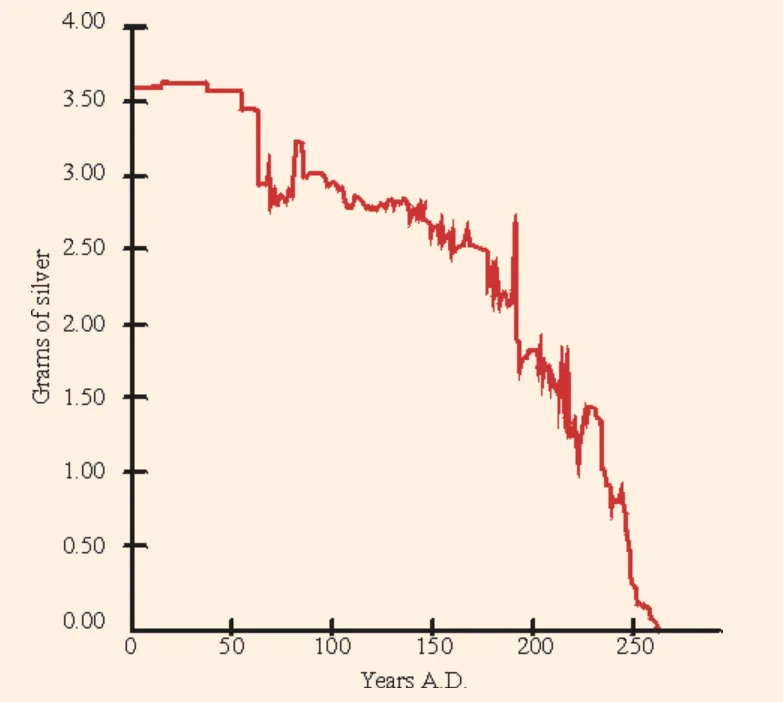
Rome joined military organisation to taxation and political integration. Conquered territory expanded the tax base, while alliances and limited frontiers reduced the cost of control. When territory and revenue shrank, the cycle reversed: less tax, weaker defence and further losses. The lesson is capacity—strategic commitments become fragile when they exceed the economic system’s ability to sustain them.
Roman silver content collapsed as imperial capacity weakened
Silver content falls from roughly 3.5 grams to almost zero by the mid-third century. It is a proxy for fiscal and monetary strain: strategic commitments become harder to sustain when the underlying resource base erodes.
Habsburg Spain illustrates the second mechanism: strategic excess. American silver and easy credit financed sprawling military commitments long after the strategy had become unsustainable. Borrowing paid for war; deficits drove more borrowing; defaults and unpaid troops produced mutiny and military weakness. Resources delayed the reckoning. They did not correct the strategy.
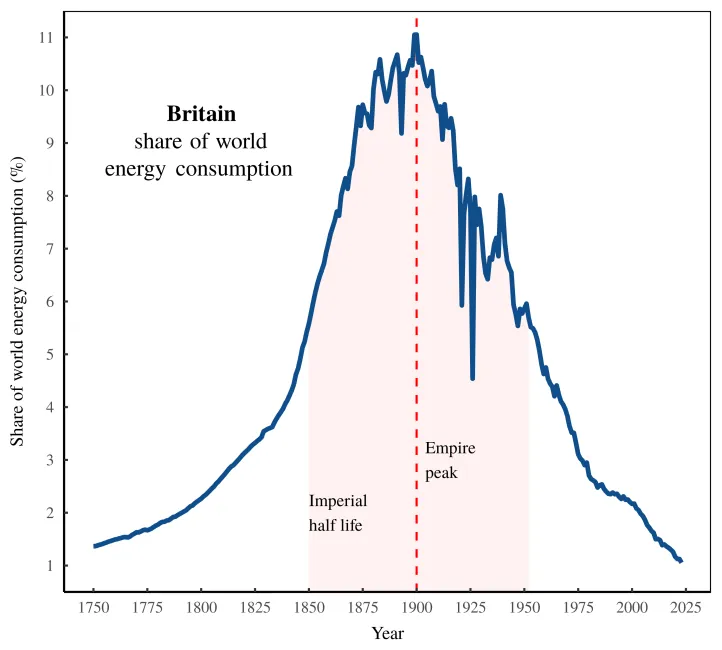
Britain illustrates the third mechanism: networks and chokepoints. Geography, industry, finance and naval strength supported control of trade routes and strategic territories. An industrial ecosystem built, fuelled and maintained the fleet, while diplomacy contained continental rivals. Britain’s reach came not only from what it owned, but from the networks others had to use.
Britain’s energy share rose with industrial power — then fell
Britain’s share of world energy use climbed to roughly 11% around 1900 before receding sharply. The point is capacity: geopolitical reach rests on a productive and energy base strong enough to sustain it.
These three mechanisms carry directly into technology: capacity, strategic discipline and control of networks. A state needs the resources to sustain critical systems, the discipline to choose which capabilities matter, and leverage over the chokepoints through which those systems operate.
A three-layer model of technological power
Technological power can be analysed through three layers: resources, infrastructure and architecture. Chips, compute, energy, cloud systems, models, data and cybersecurity sit across these layers. The framework matters because control of the connections between them can be as important as ownership of any single component.
Resource power comes from owning something others need. Oil, lithium and copper are familiar examples: scarce supply and weak substitutes give their owners leverage.
Infrastructure power comes from controlling access. Payment networks, telecoms, cloud platforms, logistics systems and energy grids carry activity between other participants. Their operators gain influence because users need the system to reach one another.
Architectural power comes from shaping the rules of the system itself. Standards, operating systems, chip architectures and protocols determine compatibility, access and the choices available to everyone building on them. A product serves a market; an established architecture helps define how that market works.
These three kinds of power often blur into one another. A company may begin by controlling infrastructure, then gain deeper influence as customers build their systems around it and find it difficult to leave. So the useful questions are straightforward: What does it control? How much do others depend on it? How hard would it be to replace? And who gets to decide the terms of access?
Architectural power often works without visible intervention. An operating system’s APIs, permissions, security rules and distribution channels define what developers can build and how they can sell it. Once institutions organise around those rules, alternatives become costly. The power sits in the environment in which decisions are made.
The three-layer model reveals different national power profiles
The United States is especially powerful because its companies run much of the digital infrastructure and shape many of the rules the digital economy relies on. American companies dominate or shape cloud computing, AI models, semiconductor design, operating systems, enterprise software, payments, internet platforms and much of the software-development stack. The US has also been central to successive waves of computing — from the PC and internet era to mobile, cloud and now AI. Its leverage goes well beyond producing technology. Large parts of the global digital economy have been built around American architectures, standards and platforms. The US government itself now describes domestic data-centre and AI infrastructure as foundational to both economic and national security.1
China combines resource and infrastructure power while trying to convert both into architectural power. Its leverage in rare earths and processing sits alongside vast manufacturing, logistics, telecommunications and industrial networks. It is also trying to build architectural power by setting more technical standards, developing domestic AI and computing architectures, building telecommunications standards and reducing dependence on foreign technological systems. Recent Chinese industrial policy pushes hard on AI standards, and my reading is that the same strategy extends to communications, electronics and other strategic sectors.2
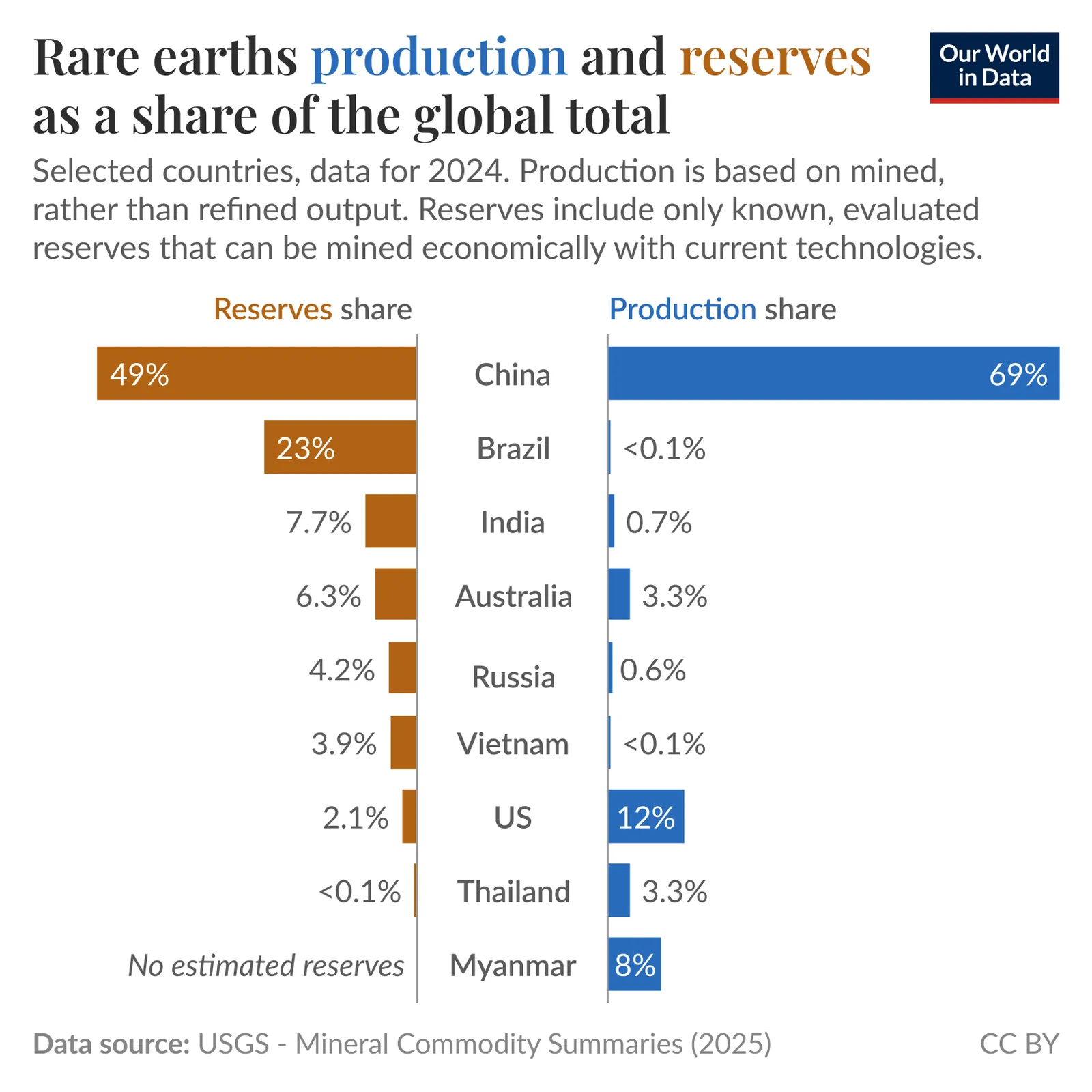
Rare-earth power comes from production, not geology alone
China holds 49% of the reserves shown but 69% of mined output; Brazil holds 23% of reserves and produces less than 0.1%. Chokepoint power comes from converting resources into usable supply.
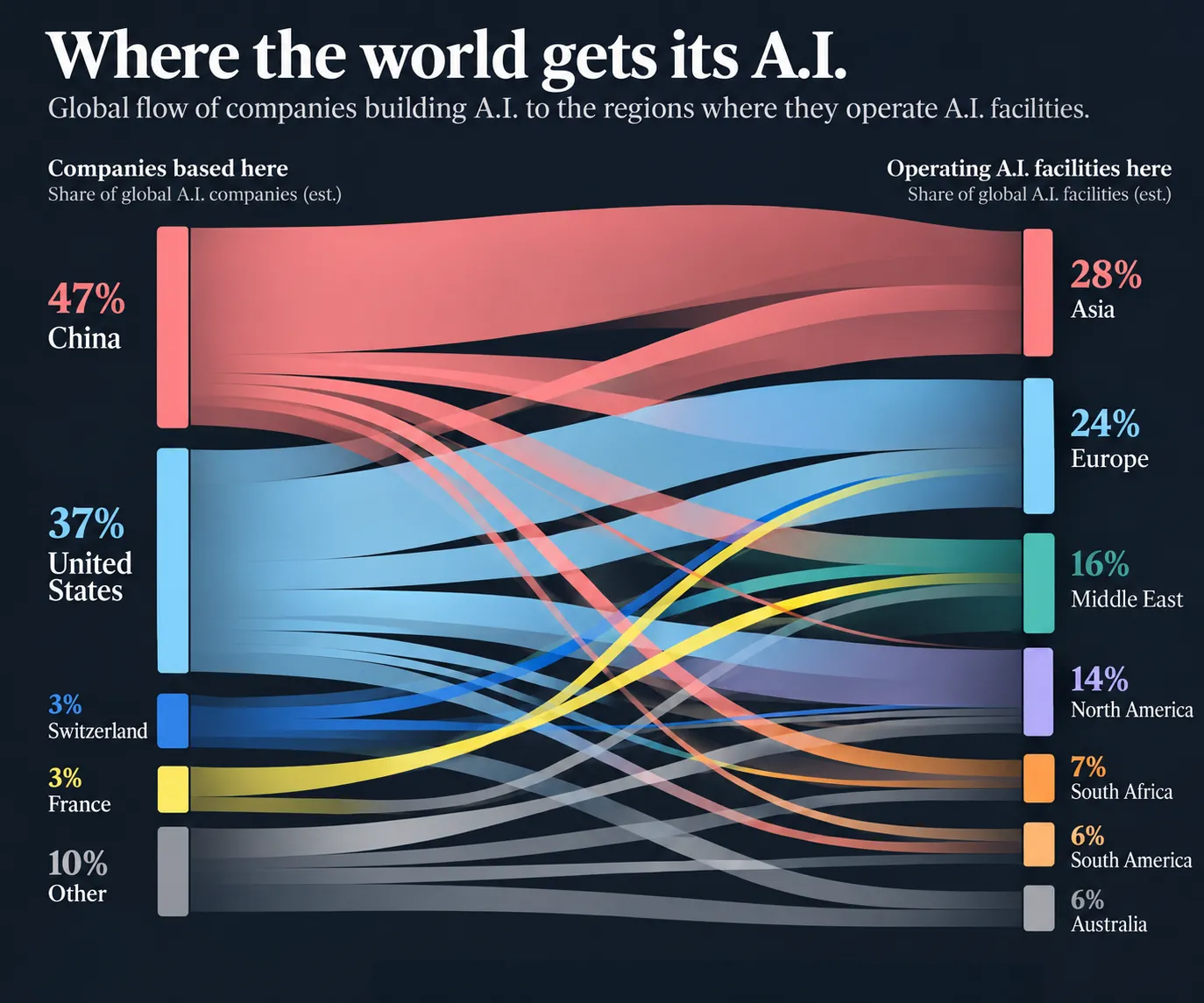
AI ownership and AI infrastructure do not sit in the same place
AI companies are concentrated in China and the US, while facilities are distributed across several regions. Sovereignty therefore has to follow the full chain: ownership, compute, energy, cloud infrastructure and jurisdiction.
India has built selective infrastructure and architectural power. Its clearest strengths are in digital public infrastructure. Aadhaar, UPI and the broader India Stack have created population-scale identity and payment rails, and India has increasingly tried to export the DPI model internationally. UPI alone processed roughly 22.6 billion transactions in March 20263, while Aadhaar exceeds 1.44 billion issued identities4.
Beyond those systems, however, India’s technology base is far less integrated.
Much of India’s software, operating-system, cloud, semiconductor and AI architecture still depends on technology developed elsewhere. India's limited domestic capability in semiconductor manufacturing, advanced compute, foundation models and research ecosystems is, in my view, a strategic vulnerability, and the government's current semiconductor and IndiaAI programmes are explicitly intended to reduce those dependencies.5 NITI Aayog similarly describes India's semiconductor strategy as a transition from high import dependence toward becoming a more important global semiconductor node.6
That distinction matters. India can be one of the world’s largest digital economies while still relying on foreign operating systems, cloud architectures, AI accelerators, semiconductor equipment and foundation-model ecosystems. Scale of use can coexist with foreign control of the architecture.
Geopolitical agency is multipolar; systemic architecture remains bipolar
“Multipolar” is everywhere—in summit communiqués, BRICS language and conference panels. It captures a real change: more countries have room to bargain and act than at any point since 1945. Geopolitical agency and architectural independence have diverged. The world is increasingly multipolar in bargaining power, but still close to bipolar in the technological and security architectures that determine systemic freedom of action.
A pole can act across security, finance and technology without another power’s permission for the capabilities it relies on. No country is self-sufficient: the United States depends on Taiwanese fabrication, and China on foreign chip-making tools. The test is net power. Can a country absorb pressure, impose costs and survive a rupture with the other major powers?
By that test, power is highly concentrated. The United States and China accounted for almost half of world military spending in 2024, at $997 billion and an estimated $314 billion respectively, according to SIPRI.7 In the same year, US-based institutions produced 40 notable AI models, China 15 and the whole of Europe three, according to Stanford's AI Index.8 The frontier of compute, models, hyperscale cloud and advanced chip design sits overwhelmingly with American firms. The frontier of manufacturing scale, critical-mineral processing, batteries and industrial supply chains sits overwhelmingly with China. No third actor holds a comparable position in either.
The gap between the two is also narrowing. The same Stanford report found that Chinese models had reached near parity with leading American models on major benchmarks by the end of 2024, despite export controls on advanced chips.9 That strengthens the bipolar case: the contest is increasingly between two comparable powers, not one leader and a field of followers.
Apply that test to the other candidates. The European Union writes rules others follow, but lacks a hyperscaler and still depends heavily on the United States for security. Russia has nuclear weapons and energy, but much of its technology and trade now runs through China. India has scale, digital public infrastructure and a doctrine of strategic autonomy, but depends on others for chips, equipment and much of its technology stack. Japan, South Korea and Taiwan are indispensable in specific layers but aligned with Washington. The Gulf states have capital and energy, yet buy advanced compute under American licence. Each matters. None can act independently across all three domains.
What looks like multipolarity is better described as multi-alignment: many countries hedging and bargaining between two centres of gravity. Their room to manoeuvre is real, but it is room around the poles, not room to become one. Europe could become a third only by pooling far more of its capabilities.
India and many European states are therefore middle powers: strong in selected domains, but still dependent on infrastructure, standards and architectures controlled elsewhere to operate at global digital scale.
The two poles also benefit from increasing returns. Scale attracts capital, talent, suppliers, developers and customers; each strengthens the ecosystem and makes its architecture harder to displace.
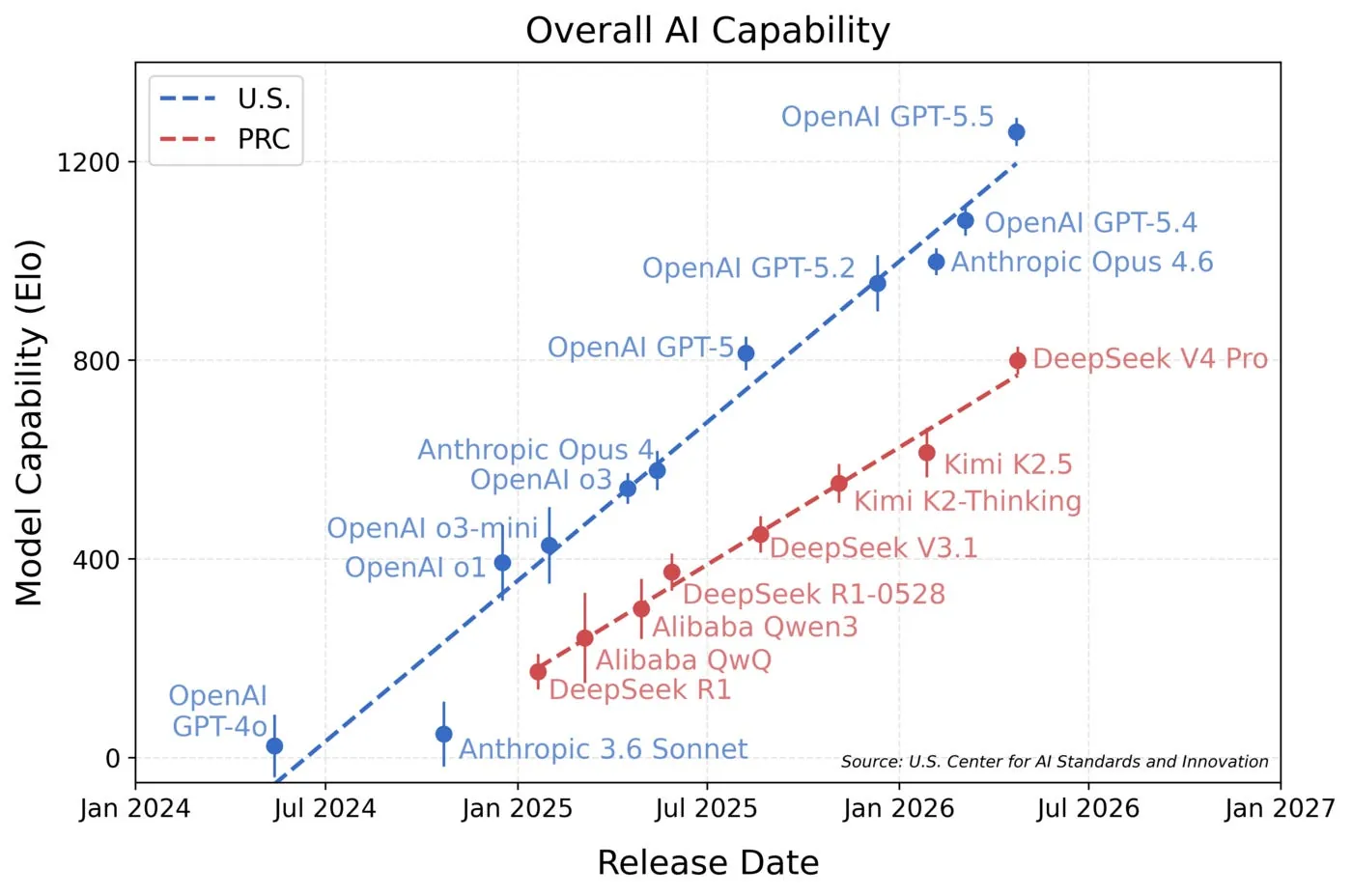
US models lead the plotted frontier; Chinese models are closing the gap
The chart tracks model capability against release date. The strategic signal is the speed of convergence: a second technology ecosystem can keep advancing despite constraints on access to frontier compute.
That is what makes their power different: the ability to shape the systems around which others organise themselves.
This power can exceed what revenue or output suggests. A large share of a replaceable product market may offer less leverage than control of an essential interface, standard or infrastructure layer used across industries.
The diplomat’s chokepoints have not disappeared; they have multiplied. Ports and sea lanes still matter, but so do undersea cables, satellites, semiconductor supply chains, cloud platforms, payment rails, AI compute, operating systems and communications networks. Power now runs through infrastructure and architecture as well as territory. But every digital dependency still rests on physical systems: fabs, data centres, energy, logistics, cables, minerals and factories.
For a middle power, the goal should not be to reproduce the entire American or Chinese technology stack. That would be too costly and unnecessary. The harder questions are which layers it must control, which dependencies it can tolerate, and where it can become indispensable to others. That is a workable definition of sovereignty in an interconnected world.
Chokepoint infrastructure and architectural power often sit beneath products
ASML is a form of chokepoint infrastructure. It supplies lithography systems required for the most advanced chips, and its importance reaches far beyond its own equipment market because so many downstream products depend on the processes those machines make possible.
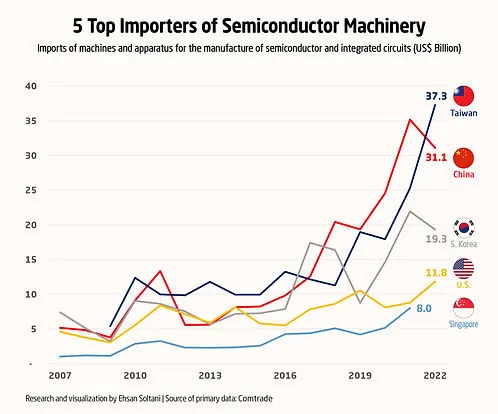
Advanced chipmaking depends on machinery concentrated upstream
Taiwan and China were the largest importers of semiconductor-manufacturing machinery in the chart, followed by South Korea, the US and Singapore. Even powerful chip economies remain dependent on specialised upstream equipment they do not fully control.
TSMC holds another infrastructure chokepoint. Advanced chip designs still have to be manufactured at scale, with demanding performance and yield. That capability is hard to reproduce. A company may own its design and still depend on someone else to make it.
NVIDIA combines infrastructure power in advanced compute with architectural power through CUDA and its software ecosystem. Developers, researchers and companies build around that combination. Replacing the chips can also mean rewriting software and changing workflows, which makes substitution expensive.
ARM is architectural power in a particularly clear form. It does not need to manufacture every chip that uses its instruction set. Its influence comes from the products, software and development choices already organised around that architecture.
The three-layer model reveals a dependency graph beneath the visible technology market. Applications rely on platforms and software tools; those rely on compute and chips; chip production relies on equipment, materials, energy and industrial skill. Standards and protocols connect the layers. There is no single ladder in which the deepest layer is always the most powerful. Leverage can appear at several points.
Cloud computing creates the same pattern. Software on AWS, Microsoft Azure or Google Cloud can become tightly coupled to proprietary databases, APIs, security services and development tools. Switching provider may then require a substantial redesign. What began as an infrastructure purchase becomes a commitment to an architecture.
Palantir raises a more sensitive issue: decision infrastructure. When software sits inside defence, intelligence, logistics or government operations, the supplier’s architecture becomes part of how the state sees and acts on the world. Sovereignty then depends on whether the state can understand, modify and keep those systems running on its own.
For investors, the question is how much activity depends on the company’s system. Market share measures sales inside a defined market. Architectural power measures how far other participants must organise their behaviour around a company’s technology, interfaces or rules.
An essential layer can create switching costs, information advantages, network effects and influence over future development. The position is strongest when users have few credible alternatives. Depth in the stack, by itself, proves little.
Strategic dependency changes the calculation of efficiency
A dependency becomes strategically dangerous when someone else can make access conditional. The Ukraine war made the use of energy, finance, technology, trade and information as instruments of competition especially visible.10 A relationship that works commercially in normal conditions can change under political pressure.
That possibility changes the meaning of efficiency. A cheap supply chain can hide concentrated geopolitical risk. A strong cloud provider can become a hard-to-replace dependency. A semiconductor source can sit inside a contested chokepoint. An energy supplier can become politically unusable.
Cost and resilience must therefore be judged together. The savings are real, but so are the costs of interruption, restricted access and hurried substitution. A system optimised for today’s price can quietly accumulate risks that appear only in a crisis.
Sovereign AI has the same problem. A country may own an application but import its semiconductors. It may build a model on foreign cloud infrastructure, or keep its data while relying on foreign software to interpret it. Even domestic servers may need external updates, security services and specialist support.
Each arrangement may make commercial sense, but each creates a different exposure. Hosting location and national branding reveal only part of the picture. The analysis has to follow the dependencies and ask who controls continued access. Sovereignty operates layer by layer: independence in one layer can coexist with dependence in another.
Selective interdependence is the best bargain available to middle powers
Most countries cannot control the whole technology system. Building domestic capability in every layer would be ruinously expensive and would still leave some reliance on foreign equipment, materials or expertise. The practical goal is autonomy in the functions where outside control could constrain national choices. In a bipolar system, the two poles constrain that choice and set many of the terms within which middle powers negotiate.
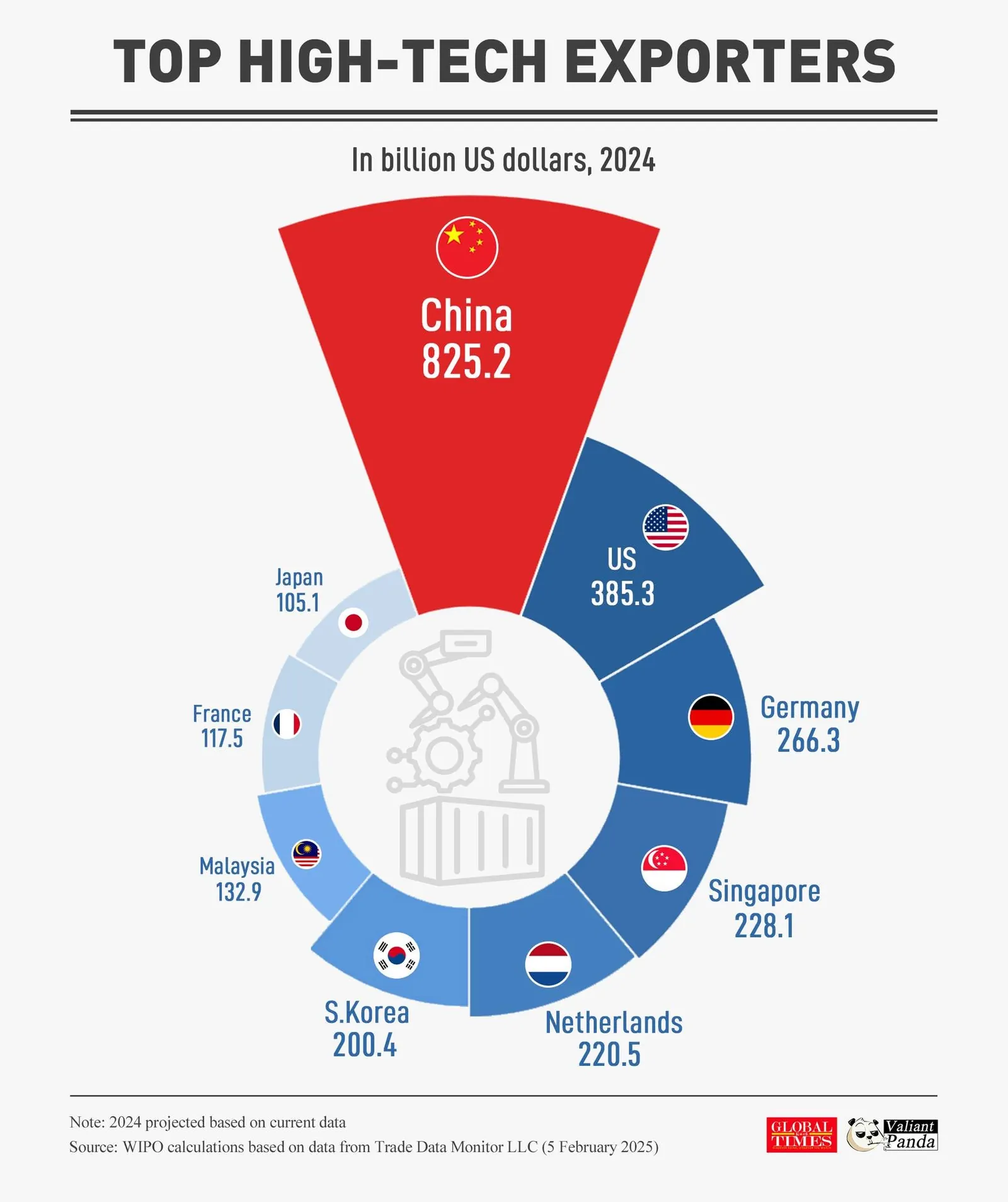
High-tech export scale and architectural power can diverge
China leads the chart at $825.2bn, more than twice the US at $385.3bn. Export scale captures industrial throughput; architectural power comes from control of cloud platforms, chip architectures, AI models, standards and other system rules.
That is selective interdependence: integrate where dependence is tolerable, build redundancy where interruption would be dangerous, and preserve independent capability where access is essential to freedom of action. That resilience carries a cost. Domestic capacity competes for limited budgets, and the lessons of Rome and Habsburg Spain still apply: commitments cannot outrun capacity. A middle power must decide which risks it will knowingly leave open.
This also clarifies decoupling. The objective is enough independent capacity to stop another system dictating a country’s choices while preserving trade where dependence remains tolerable. The US–China semiconductor conflict shows how governments can protect critical capabilities while trade continues elsewhere.
Globalisation and fragmentation can advance together. Trade, capital and multinational supply chains can remain extensive while governments add industrial policy, export controls, sanctions and domestic capacity in selected sectors. States still want the gains from integration; they also want more control over the terms.
The hubs increasingly set those conditions. Interdependence creates efficiency, but it also creates a channel for coercion. Whoever controls a hub (a payment network, a chip architecture, a cloud platform, an export-control regime) can monitor or cut off those connected to it. American controls on semiconductor technology reach well beyond American territory, and the Netherlands restricted ASML's exports to China even though ASML is a Dutch company.11 Hedging carries a price too. The United Kingdom reversed its decision to allow Huawei into its 5G network in 2020 under sustained American pressure.12 In a bipolar system, keeping a credible alternative often means keeping a relationship with the other pole, and that is treated as choosing a side.
This does not require two clean technological blocs. One system might combine American finance, Taiwanese fabrication, Dutch lithography, Chinese manufacturing, European regulation, Gulf energy and Indian digital infrastructure. But the arrangement lasts only while the poles tolerate it. A Taiwan crisis or full US–China rupture could break several layers at once. Selective interdependence has to be designed for that stress as well as normal conditions.
Open-weight models put that principle into practice. A state that can run, fine-tune and audit a model on infrastructure it controls depends less on a single foreign provider than one that reaches the same capability only through an API. The dependency does not vanish; it moves down the stack to compute, chips, energy and talent. Even the openness is conditional. Firms and governments in the two poles decide which weights to release, and what is available today can be restricted tomorrow.
For middle powers, the task is narrower than full autonomy. They can build indispensable capabilities in selected areas, negotiate access to larger systems and maintain alternatives in their most exposed functions. A narrow strength matters only if others truly need it and it preserves room to act.
Indispensability can coexist with strategic exposure. ASML and TSMC are essential, yet the Netherlands and Taiwan remain exposed to larger powers; a chokepoint can make its owner a target as easily as a bargainer. Narrow strengths become more useful when pooled. The Quad, US–India technology partnerships and European industrial programmes allow middle powers to bargain collectively over terms they could not set alone. India’s multi-alignment follows the same logic. Selective interdependence is a constrained bargain under bipolar pressure, and it lasts only while a middle power offers something the poles cannot easily do without.
States and investors need to understand the dependency graph
Governments should start by mapping which critical functions depend on external systems. For each one, they need to know who controls access, what could interrupt it, how long replacement would take and whether the state could keep operating during the transition.
The response should match the exposure. Some dependencies can be accepted. Others justify multiple suppliers, replaceable components, reserves or domestic capability. Trying to remove every foreign input can waste resources while leaving the most serious vulnerabilities untouched. Strategic discipline means focusing on the dependencies whose loss would constrain action.
For investors and deep-tech companies, this changes the opportunity set. Total addressable market still matters, but it can miss a company’s position inside a much larger system. A small direct market may contain a component on which enormous downstream activity depends.
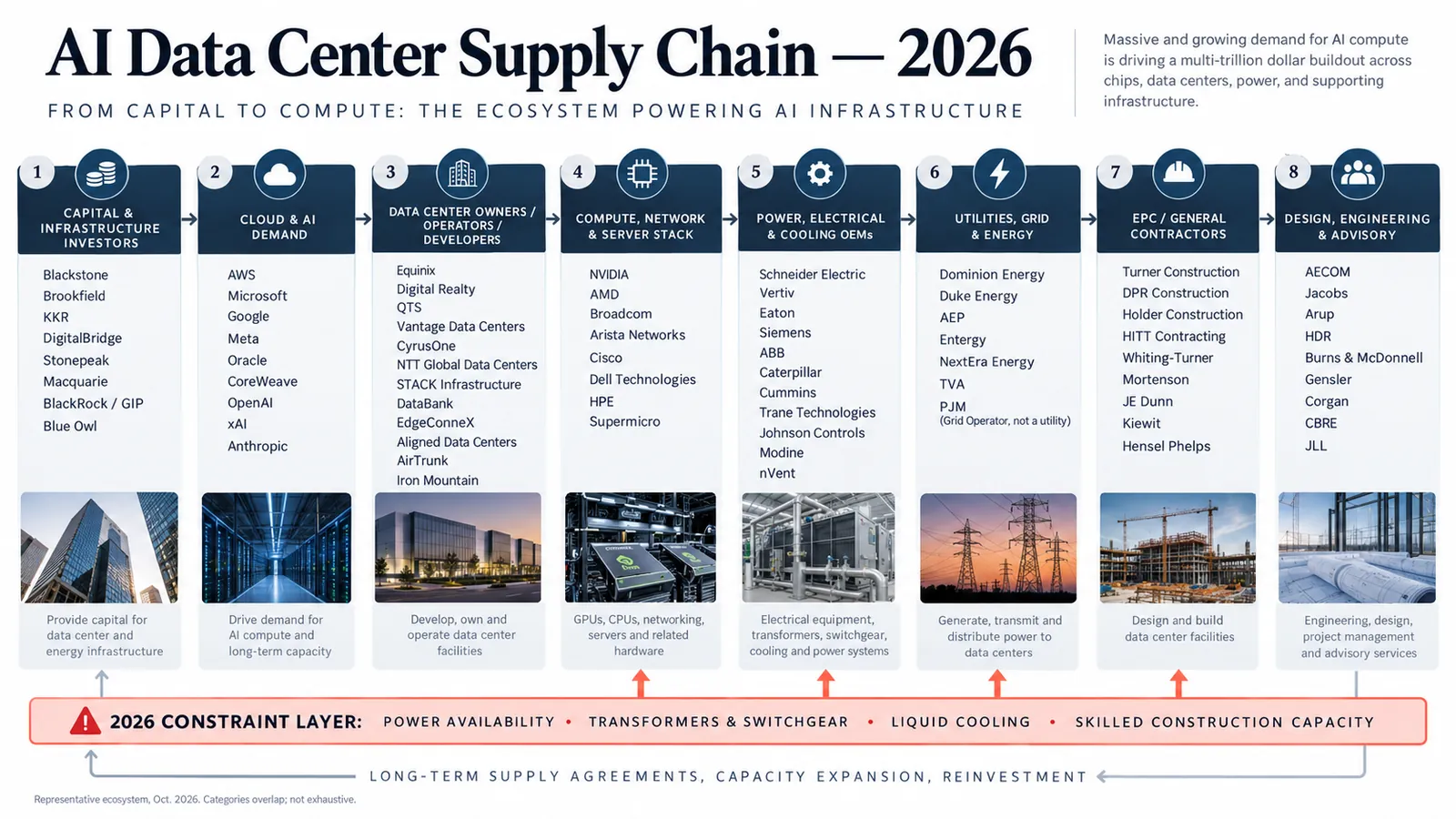
AI infrastructure is a chain of dependencies — and the bottlenecks sit below compute
The 2026 stack runs from capital and cloud demand through data centres, compute, power, utilities, construction and engineering. The constraint layer is more revealing than the application layer: power availability, transformers, switchgear, liquid cooling and skilled construction capacity are where scarcity — and bargaining power — can accumulate.
The questions are concrete. Which systems depend on the company? How hard is its capability to reproduce? Who controls the interfaces and standards? Can customers replace it without redesigning their operations? And does that essential position produce durable returns?
A company does not need to own the whole platform. It can build a strong position through one indispensable module—provided it also understands the suppliers and rules on which that module depends.
The historical lesson is straightforward. Economic capacity creates options; institutions and strategic discipline determine how well they are used. Technology changes the instruments of influence and creates new dependencies, but ownership and scale still do not guarantee durable power.
That produces a four-question sovereignty test for any critical AI system or supplier: Can the state inspect the system and understand how it makes decisions? Can it operate the system independently if the supplier withdraws? Can it substitute the supplier without rebuilding the entire architecture? Can it preserve critical functions during the transition? The Palantir question—and every similar procurement decision—should be answered against those four tests.
A no answer to any of those questions means the procurement also creates a dependency that can become conditional. Sovereign AI therefore means the freedom to keep critical functions running and preserve meaningful choices when cooperation becomes conditional. National branding or domestic hosting alone cannot provide that freedom.
References
- 1Executive Order 14318, “Accelerating Federal Permitting of Data Center Infrastructure” (23 July 2025), and the accompanying White House report Winning the Race: America’s AI Action Plan (July 2025). EO 14318 revoked the earlier EO 14141, “Advancing United States Leadership in Artificial Intelligence Infrastructure” (14 January 2025), which had framed domestic AI infrastructure in the same national-security and economic-competitiveness terms.
- 2Ministry of Industry and Information Technology (MIIT), Cyberspace Administration of China, National Development and Reform Commission and Standardization Administration of China, Guidelines for the Construction of a Comprehensive Standardization System for the National Artificial Intelligence Industry (2024 Edition), July 2024. The guidelines target more than 50 new national and industry AI standards by 2026 and Chinese participation in more than 20 international standards.
- 3National Payments Corporation of India (NPCI), UPI monthly statistics: 22.64 billion transactions worth ₹29.53 lakh crore in March 2026.
- 4Unique Identification Authority of India (UIDAI), State/UT-wise Aadhaar Saturation Report (as of 30 June 2026): 1,44,80,05,767 Aadhaar numbers assigned.
- 5Union Cabinet approval of the IndiaAI Mission, Press Information Bureau, 7 March 2024 (outlay ₹10,371.92 crore over five years, including more than 10,000 GPUs and indigenous foundation models); IndiaAI, Ministry of Electronics and Information Technology, which describes the mission as intended to “bridge the gaps in the existing AI ecosystem”; Press Information Bureau, 13 February 2026 (more than 38,000 GPUs onboarded; twelve teams shortlisted for indigenous foundation models).
- 6NITI Aayog Frontier Tech Hub, Future of India’s Semiconductor Industry (May 2026). The report finds that 90–95 per cent of India’s semiconductor demand is met by imports and sets out a roadmap to make India an indispensable participant in the global semiconductor value chain by 2035.
- 7SIPRI, “Trends in World Military Expenditure, 2024”, Fact Sheet, April 2025. World military expenditure was $2,718 billion in 2024.
- 8Stanford Institute for Human-Centered Artificial Intelligence, Artificial Intelligence Index Report 2025 (April 2025), drawing on Epoch AI’s database of notable AI models.
- 9Stanford HAI, Artificial Intelligence Index Report 2025. Performance gaps on benchmarks such as MMLU and HumanEval narrowed from double digits in 2023 to near parity in 2024.
- 10On 26 February 2022 the United States, the European Commission, the United Kingdom, Canada, France, Germany and Italy jointly announced the removal of selected Russian banks from SWIFT and restrictions on the Central Bank of Russia’s foreign-exchange reserves. Russia in turn repeatedly cut and suspended pipeline gas supplies to the EU during 2022.
- 11Dutch government export-control regulations on advanced semiconductor manufacturing equipment, announced 8 March 2023 and published 30 June 2023, in force from 1 September 2023, requiring licences for ASML’s most advanced immersion DUV lithography systems; see ASML statements of 8 March and 30 June 2023.
- 12UK Government (Department for Digital, Culture, Media and Sport), announcement of 14 July 2020 that Huawei equipment would be removed from UK 5G networks by the end of 2027, reversing the January 2020 decision to allow Huawei a limited role. The reversal followed US sanctions on Huawei announced in May 2020.