Seed valuations are telling two very different stories.
For most founders, Seed still means raising a few million dollars at a valuation in the tens of millions. But at the top of the market, especially in AI and other capital-intensive sectors, some companies are raising Seed rounds at valuations above $200 million. Put those deals in the same bucket and the market looks far hotter than it feels for the typical startup.
The more useful question is what a company must become for a particular price to work. If an investor enters at a $50 million valuation, how large does the business eventually need to be, and how much revenue must it produce for the investment to matter to the fund?
This analysis works backward from that question. It separates the different markets now hiding behind the Seed label, then connects entry price to ownership, dilution, exit value and revenue. A deliberately demanding example shows how a $50 million post-money valuation can point toward a $14.0 billion exit and roughly $1.40 billion in ARR. It is an underwriting test rather than a prediction.
The Seed market has split into three capital markets
Seed rounds used to look mainly like ownership negotiations: how much capital the company needed, how much equity founders would sell and how much risk investors were taking. That kept most deals within a fairly narrow band. In 2026, the band has widened unevenly.
The median Q2 2026 Seed round raised about $4.5 million at a $23.9 million post-money valuation; median dilution was 19.4%. Software was similar: roughly $4.1 million raised, a $24.3 million valuation and about 18% dilution. Because these are independently calculated medians, round size divided by valuation does not necessarily equal the reported median dilution. The top end is a different story. The 95th-percentile Seed valuation jumped from $72.2 million in Q2 2025 to $200.4 million in Q2 2026, an increase of about 178% in a year.1
Seed valuation percentiles expanded sharply at the upper tail
The median moved, but the most dramatic repricing sits in the top decile and especially the top 5%.
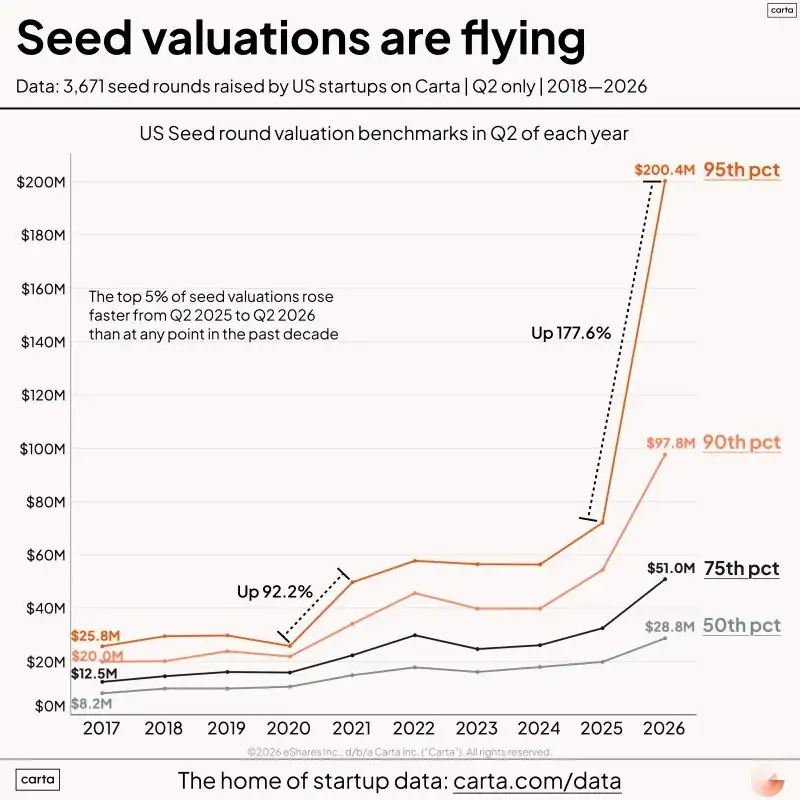
That widening gap changes how the headlines should be read. A typical financed company may still be valued around $20 million to $25 million, even as the top 5% approaches or clears $200 million. Seed valuations have become more dispersed, with most of the increase concentrated at the upper end.
The gap between the middle and upper tail has widened
The distance between the 50th and 90th percentiles has expanded materially even before the extreme 2026 outliers are added.
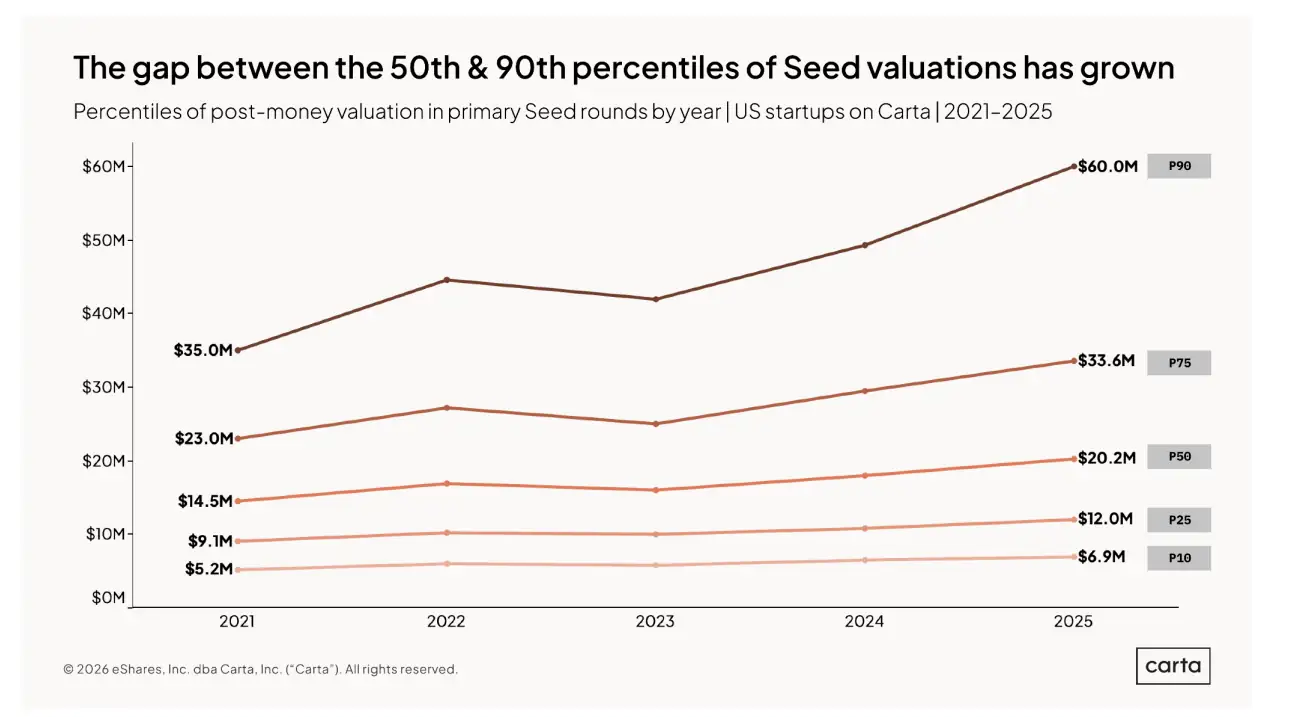
A single stage label now hides three financing products
“Seed” now describes three quite different financing products. Round size, company maturity and capital intensity vary too much for a single stage label to capture the underlying risk.
| Seed segment | Typical round size | Typical company profile | Underwriting implication |
|---|---|---|---|
| Regular Seed | $2m to $10m | Conventional software and technology startups, including Cascade, Dessn and Niteshift | Ownership, graduation and capital efficiency dominate |
| Big Seed | $10m to $50m | Larger extensions, capital-intensive companies and multi-stage rounds, including Sapiom, Meridian and Scout AI | Milestone burden and future dilution rise materially |
| Outlier Seed | $50m to several hundred million | Frontier AI, robotics, scientific computing and infrastructure, including Entire and Genesis AI | Return depends on a rare multi-billion-dollar outcome |
Regular Seed still describes the conventional market: a few million dollars of capital at post-money valuations in the tens of millions. Big Seed includes larger extensions and capital-intensive businesses. Outlier Seed often provides the first institutional backing of an elite technical team.
The upper tail can distort the headline market
At the very top, a handful of 2026 Seed rounds were priced like late-stage companies:
| Company | Focus | Announced | Seed raised | Reported valuation | Lead investors |
|---|---|---|---|---|---|
| Ineffable Intelligence2 | Reinforcement-learning lab | Apr 2026 | $1.1bn | $5.1bn | Sequoia, Lightspeed |
| AMI Labs3 | World-model AI lab | Mar 2026 | $1.03bn | ~$4.5bn post-money | Cathay Innovation, Greycroft, Hiro Capital, HV Capital, Bezos Expeditions |
| humans&4 | AI research lab | Jan 2026 | $480m | $4.48bn | Backers include Nvidia, Jeff Bezos and GV |
| Flapping Airplanes5 | AI research lab | Jan 2026 | $180m | $1.5bn | GV, Sequoia, Index Ventures |
| Inferact6 | AI inference | Jan 2026 | $150m | $800m | Andreessen Horowitz, Lightspeed |
The pattern behind these rounds is narrow. Almost all are research labs or frontier-AI infrastructure companies, founded by researchers with recognised track records at organisations such as DeepMind and Meta, and backed by a small group of large, well-capitalised investors. These investors are paying for scarce research talent and an option on a platform-scale outcome, from funds large enough to wait years for revenue. That is a different product from an ordinary Seed round, and these deals should not be used as comparables for the rest of the market.
Aggregate funding totals therefore become easy to misread. A single $500 million Seed round counts as much as five hundred $1 million rounds. A handful of giant transactions can transform the headline without making capital any easier to raise for an ordinary founder.
AI companies sit above the Seed market on round size and valuation
The 2026 premium is concentrated in categories where capital intensity, scarce technical talent and frontier-model economics are unusually important.
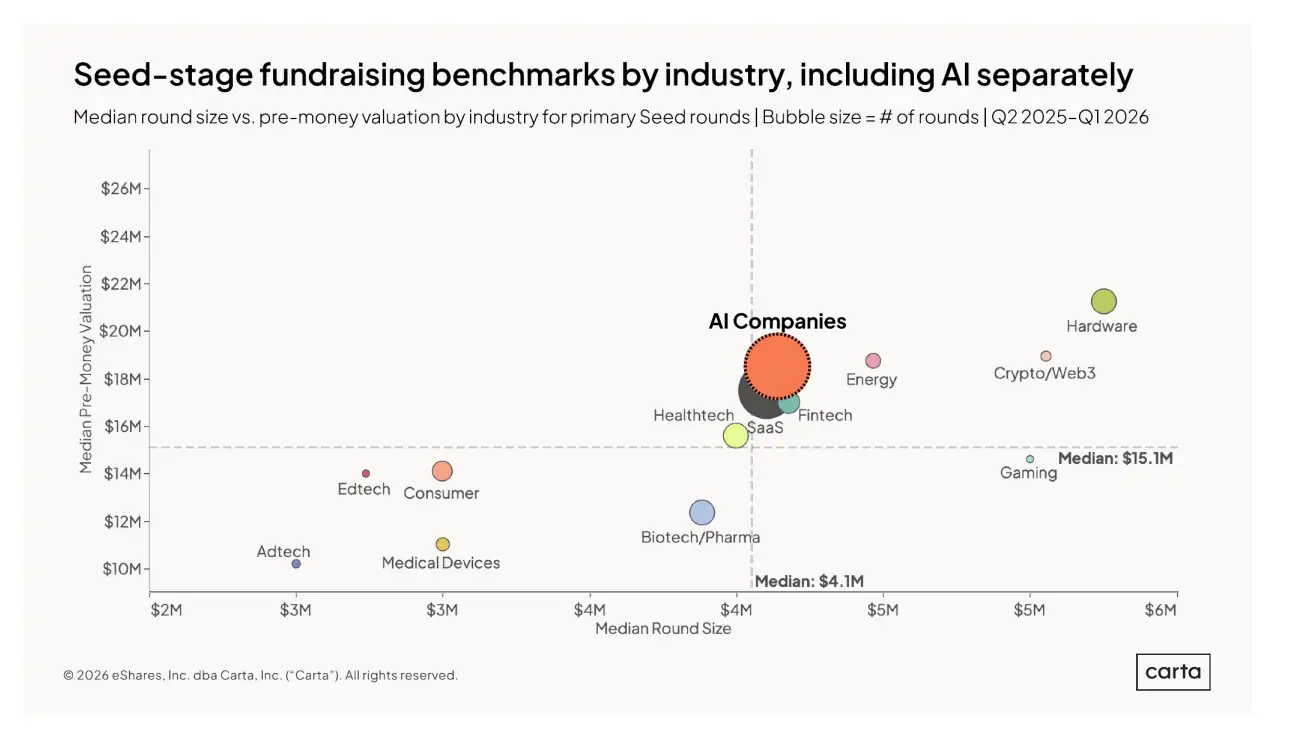
The split is geographic as well as sectoral. The Q1 2026 median pre-money SaaS Seed valuation was $33.3 million in the Bay Area, versus $24.5 million in New York and $12.7 million across the rest of the United States.7 Capital, technical talent, repeat founders and specialist investors are clustering in the same places.
AI drives the upper tail; ordinary financing remains tight
AI is the clearest explanation for the most extreme Seed prices. In Q1 2026, AI companies took over 60% of venture dollars in the quarter and beat the broader market on round size and valuation at both Seed and Series A.8
Those investments range from frontier models and robotics to AI infrastructure, scientific AI and specialised applications. The premium reflects specific bets about how these businesses will grow.
Operating leverage can support a genuine premium
Talent data helps explain the economic case. Early-stage engineering hiring stood about 7% above 2019 levels, while marketing hiring was 18% lower and design hiring 22% lower. Engineers rose from roughly 46% to 55% of hiring at major technology companies. New-graduate hiring fell sharply; engineering and product managers, meanwhile, were overseeing wider technical teams.9
The model taking shape uses fewer people, leans more heavily on senior technical talent and automates more work. If revenue can grow much faster than headcount, revenue per employee and margins can rise with it. A higher valuation today therefore rests on the prospect of stronger future cash flows.
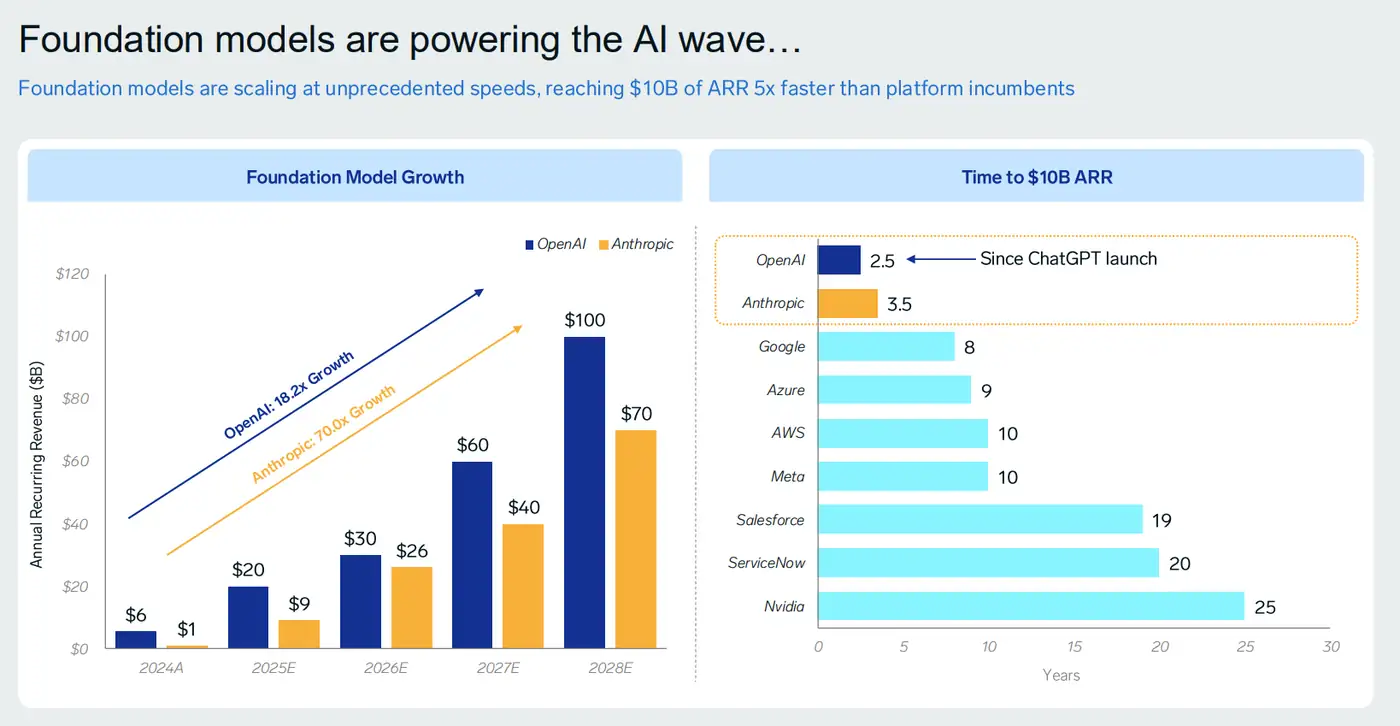
Foundation-model companies illustrate the growth assumptions behind the AI premium
The case for frontier valuations ultimately requires operating growth that is unusually fast, not simply a higher private-market multiple.
Scarce teams and large capital needs also raise prices
Some Seed investors are effectively underwriting scarce talent before meaningful revenue exists. AI and machine-learning engineers, research engineers and forward-deployed engineers command a premium, while the old junior-engineering pyramid has narrowed. A team built by recognised researchers or executives from frontier organisations may be priced on the chance that it captures a very large market.
Large capital requirements create a second effect. Early-stage valuations often fall out of two numbers: the cash raised and the equity sold. If founders sell about 20% of the company, a larger round mechanically produces a larger post-money valuation:
This matters in frontier AI, robotics, semiconductors, biology and infrastructure, where a company may need substantial capital long before commercial maturity. Part of the stated valuation may simply reflect what it costs to build the business without pushing founder dilution past an acceptable level.
A harder financing market sits beneath the upper tail
Most founders operate in a much tighter market. The time from Seed to Series A remains elevated even as headline valuations set records.10 That longer financing path increases the importance of runway, milestone planning and capital efficiency.
The result is a two-speed market. Companies with exceptional founder pedigree, AI exposure, rapid traction and a large addressable market can move quickly through Seed and Series A. Everyone else faces longer fundraising cycles, higher proof requirements, more extensions and tighter pressure to conserve cash.
Seed extensions and extra SAFEs are now part of the normal financing path. A founder might give up 18% to 20% at Seed, another 5% to 8% through instruments issued before Series A, and then 18% to 23% in the A itself. A high Seed valuation delays dilution while raising the milestones needed to defend that price.
Entry valuation is only one part of expected value. Access to the next round and the odds of graduating to it also determine whether a seemingly cheap company survives long enough to produce a return.
Fund math turns an entry price into an exit target
A disciplined underwriting process starts with the return the fund itself needs to earn. Venture is illiquid, takes years to mature and loses money on many investments. Over ten years, a 15% annual return compounds to about 4.0x:
A $100 million fund therefore needs about $400 million in gross proceeds to reach 4.0x. With 35 equal initial investments and one company carrying the entire outcome, the winner must return 140x the original investment before dilution:
Now add dilution. If later rounds cut the original ownership in half, the company’s valuation must rise roughly twice as much:
A $50 million Seed can imply a $14.0 billion exit
Apply that 280x requirement to a $50 million post-money Seed valuation and the target becomes:
A $1 billion exit from a $50 million entry is 20x valuation appreciation, but after ownership is cut in half the fund’s stake returns only about 10x its cheque, roughly $29 million, or 0.29x the fund. That is still a remarkable company. It just cannot carry this fund.
Required outcomes rise rapidly with entry valuation
Every extra $10 million of entry price adds $2.8 billion to the required exit and $280 million to the required ARR under the worked-example assumptions.
| Seed valuation | Required exit at 280x | Required ARR at 10x |
|---|---|---|
| $10m | $2.8bn | $280m |
| $15m | $4.2bn | $420m |
| $20m | $5.6bn | $560m |
| $30m | $8.4bn | $840m |
| $40m | $11.2bn | $1.12bn |
| $50m | $14.0bn | $1.40bn |
| $75m | $21.0bn | $2.10bn |
| $100m | $28.0bn | $2.80bn |
Ownership provides the cleaner professional model
The 280x shortcut builds intuition; modelling ownership directly shows the economics more clearly. Suppose the fund invests $2.86 million in a company valued at $50 million post-money:
That is enough to return 4.0x on a $100 million fund. The same framework can accommodate follow-on reserves, pro-rata participation, uneven position sizes and returns from several winners.
A diversified portfolio halves the requirement
Real funds rarely depend on a single company. A successful portfolio may include one enormous winner, several positions returning 10x to 20x, a few at 3x to 8x, and many losses. Reserves can also put more capital behind the strongest companies. Keep the same $100 million fund, 35 cheques of $2.86 million and 50% dilution, but assume one large winner, three companies returning 15x, four returning 5x, five returning capital and 22 losses.
The rest of the portfolio delivers about half of the $400 million target, so the winner needs to return only about $200 million: 70x its cheque, or 140x valuation appreciation after dilution.
A strong supporting cast halves the required exit and the required ARR. It also shows what the fund is relying on: if the mid-sized winners fail to appear, the requirement goes back to $14.0 billion.
As entry prices rise, ordinary successful outcomes stop being large enough to generate top-tier fund returns. Fund size matters too. A $1 billion exit can transform a $30 million fund, help a $300 million fund, and barely register for a multi-billion-dollar platform. Large funds need enough ownership and a large enough cheque for a rare outcome to move the whole portfolio.
Multiple compression turns an exit target into a revenue target
An exit value tells you what the company must be worth, but not what it must actually achieve. Buyers and public markets often value software companies as a multiple of annual recurring revenue. Reversing that relationship shows the operating burden:
For the $14.0 billion exit required in the worked example, a richer multiple means less revenue is needed, and a lower multiple means more:
The spread is wide. At 12x, the company needs about $1.17 billion of ARR; at 10x, $1.40 billion; and if markets pay only 5.7x, it needs about $2.46 billion. Every entry valuation therefore carries an implied future revenue target. That target becomes harder to reach when the multiple investors pay at entry is higher than the multiple available at exit, because revenue must grow fast enough both to build value and to offset the falling multiple.
Real exits show how wide that range is in practice.11
| Company | Exit route | Exit value | Revenue basis | Implied multiple |
|---|---|---|---|---|
| Wiz | Acquired by Google (announced Mar 2025) | $32.0bn | ~$500m–$700m ARR at signing | ~45x–65x |
| Figma | IPO (Jul 2025, $33/share) | ~$19bn | $749m 2024 revenue | ~25x |
| CoreWeave | IPO (Mar 2025) | ~$23bn | $1.9bn 2024 revenue | ~12x |
| Figma | Public trading (Aug 2026) | ~$13bn EV | $1.3bn LTM revenue | ~10x |
| Splunk | Acquired by Cisco (announced Sep 2023) | $28bn | $3.65bn 2023 revenue | ~7.7x |
Scarce, fast-growing strategic assets can command 30x or more in an acquisition, but they are exceptions. Figma’s multiple fell from about 25x at its IPO price to about 10x within roughly a year of listing, and a mature software acquisition such as Splunk cleared below 8x. These figures sit close to the 5.7x to 12x range used in this analysis.
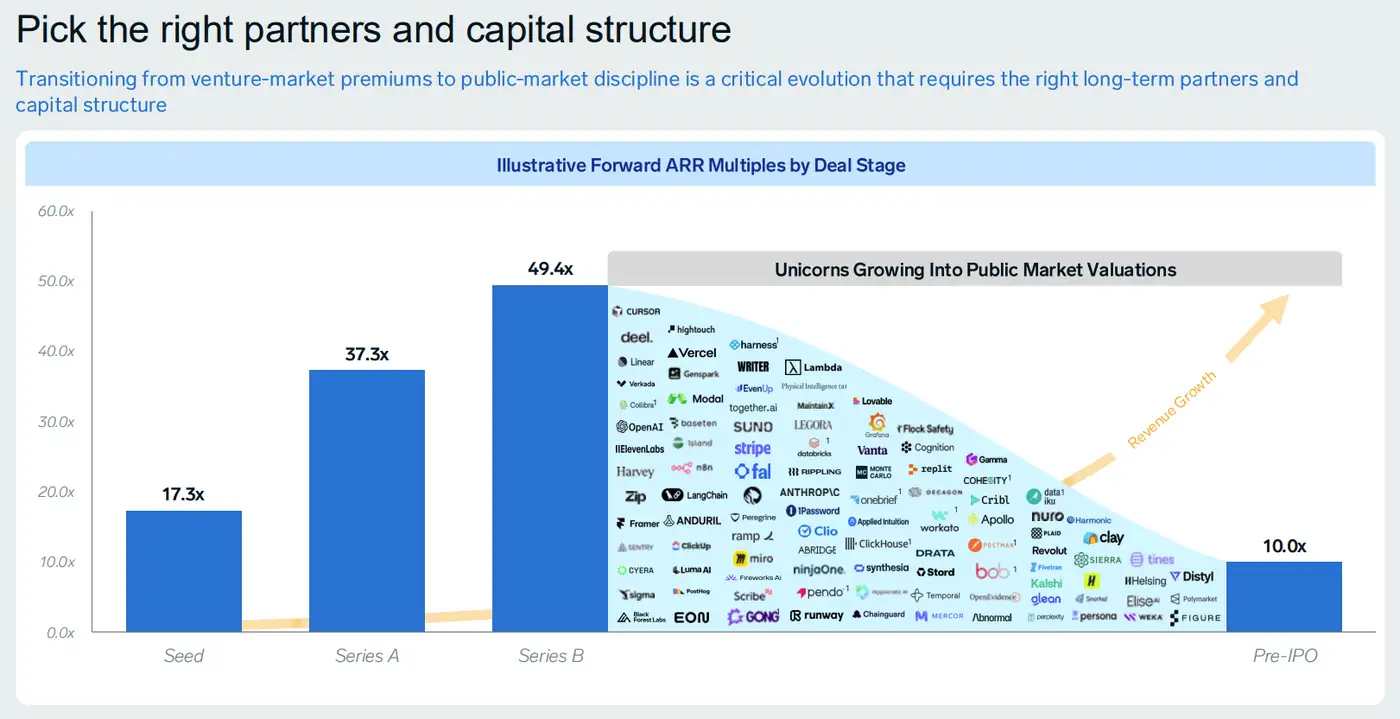
Private-market multiples can expand before converging toward public-market discipline
The underwriting problem is not only revenue growth. It is revenue growth through a valuation regime that may become less generous as the company matures.
Revenue growth must outrun multiple compression
The return can be split into operating progress and the valuation framework applied to it:
| Entry stage | Entry multiple | Terminal multiple | Revenue growth to hold value flat |
|---|---|---|---|
| Seed | 17.3x | 10.0x | 1.73x |
| Series A | 37.3x | 10.0x | 3.73x |
| Series B | 49.4x | 10.0x | 4.94x |
The Series B example is especially unforgiving. A company bought at 49.4x ARR and eventually valued at 10x must grow revenue 4.94x merely to preserve its valuation. To produce a 10x valuation return from there, revenue must grow about 49.4x.
The $50 million Seed requires roughly 484x ARR growth in the worked example
If a $50 million Seed valuation equals 17.3x forward ARR, the company is entering at about $2.89 million of ARR. The exit target is still $14.0 billion, or $1.40 billion of ARR at a 10x public-market multiple:
That is the real operating burden: ARR compounding at roughly 86% a year for a decade, while the company absorbs dilution, raises follow-on capital and moves from private-market premiums to a sustainable public-market multiple.
Private marks can exaggerate economic progress
Private-market marks can rise for two different reasons: the business grows, or the multiple expands. Consider a company whose ARR climbs from $5 million to $20 million while its valuation multiple rises from 17.3x to 49.4x:
Revenue is up 4.0x and the marked valuation is up about 11.4x. Multiple expansion, at about 2.9x, contributes nearly as much of the apparent return as revenue growth. If ARR then grows fivefold to $100 million while the multiple normalises to 10x, the company is worth about $1.0 billion. The business has delivered exceptional growth. Its value has barely moved from the last private mark.
Entry stage changes where the return comes from. Seed investors have more time to benefit from revenue growth and, sometimes, multiple expansion, though dilution works against them. Later investors have less time and may be betting on revenue growth just as multiples begin to contract.
Start with the plausible outcome, then solve for price
Treat valuation as the output of a return model. Start with the outcome that seems commercially plausible, then work backward to the price that can still deliver the required return.
If a strong company has a plausible $5 billion exit and the portfolio requires 280x valuation appreciation, the entry ceiling is about:
The $17.9 million figure is an illustrative ceiling under these assumptions. Price should follow from ownership, dilution, portfolio contribution and plausible terminal economics, independent of the price cleared by neighbouring deals.
Market size and share must support the required revenue
At $1.40 billion of ARR, a 10% share requires a market of about $14.0 billion; a 5% share requires about $28.0 billion. The revenue target still has to fit the addressable market, the competitive structure, the pricing model and the time available before exit.
Graduation risk belongs inside the valuation decision
The financing path has to be tested alongside the exit model. A cheaper company unable to reach Series A may be a worse investment than a more expensive company with exceptional growth and real financing momentum. Four questions belong in the same underwriting discussion:
- Can the company reach the operating milestones required for its next institutional round?
- Will its capital needs create additional dilution before those milestones are reached?
- Does its operating model support the growth and margins implied by the premium valuation?
- Can the fund obtain enough ownership for the plausible outcome to matter at the portfolio level?
Premium prices need exceptional economics
The 2026 Seed market combines real repricing at the frontier with heavy concentration everywhere else. Conventional Seed still lives in the tens of millions. AI and capital-intensive companies have pushed the upper end into the hundreds of millions. The same stage label now covers very different investments.
Some of those premiums have a genuine economic basis. AI-native companies may grow faster with smaller teams, scarce technical talent and stronger long-run margins. Capital-intensive companies may also need large rounds before they are commercially mature. Each company still has to prove it in its operating results.
The fund math still decides the outcome. A higher entry price demands a larger exit, more ARR or a richer terminal multiple. Dilution raises the bar again. If the multiple compresses, years of strong operating progress may pass before the valuation moves beyond the last private mark.
The useful question is concrete: once today’s private-market multiple settles at a sustainable level, how much ARR must the company produce—and can it get there within the market, time, financing and ownership constraints of the fund?
A premium price is defensible when the answers support the required outcome. If the case depends on heroic market share, permanently elevated private multiples or uninterrupted access to fresh capital, the price has already removed too many ordinary successes from the return distribution.
References
- 1Carta. “Seed Funding: Q2 2026 Startup Fundraising Insights” (updated September 2026) and “Top seed valuations are soaring” (8 July 2026). Round-size, valuation and dilution medians are independently calculated.
- 2Cooley. “Ineffable Intelligence Secures $1.1 Billion Seed Financing” (30 April 2026). The announcement reports a $5.1 billion valuation.
- 3Singapore Economic Development Board; TechCrunch. “AMI Labs raises USD 1.03 billion in largest-ever European seed round” (11 March 2026), with contemporaneous TechCrunch coverage.
- 4Reuters. “AI startup Humans& raises $480 million at $4.48 billion valuation” (20 January 2026).
- 5Flapping Airplanes; U.S. SEC. Company announcement (7 January 2026) and Form D filed 30 January 2026, recording a $180.45 million offering.
- 6Inferact. “Inferact Launches with $150M Seed Round to Solve AI Inference” (20 January 2026). The company reports an $800 million valuation.
- 7Carta. Q1 2026 median pre-money SaaS Seed valuations by region.
- 8Carta. “AI startup fundraising trends: Q1 2026” (13 May 2026).
- 9SignalFire. 2026 talent research on early-stage hiring by function and engineering share of hiring.
- 10Fenwick, Venture Beacon. Q1 2026 research on time from Seed to Series A.
- 11Exit-market sources. Wiz transaction value and revenue from company/deal announcements; Figma IPO pricing and revenue from its S-1 and public-market reporting; CoreWeave IPO valuation and 2024 revenue from its public filings and IPO reporting; Splunk transaction value and 2023 revenue from Cisco and Splunk. Multiples are approximate and use the revenue basis shown.