The evidence you can see is selected
The returning aircraft reveal where damage was survivable; the missing aircraft contain the fatal patterns excluded from the observed sample.
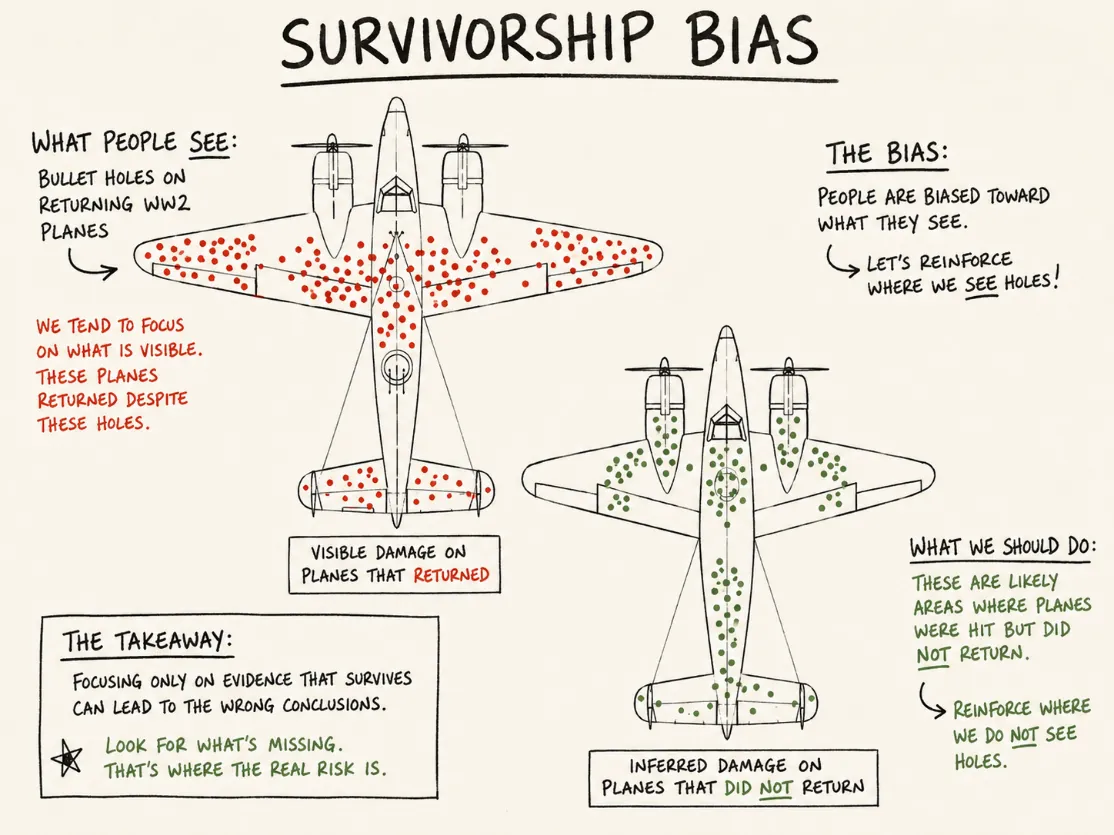
Abraham Wald changed survival analysis by reconstructing the evidence missing from the observed sample.
During the Second World War, engineers examined aircraft that had returned from combat. Bullet holes clustered across their wings and fuselage, leading engineers to propose reinforcement in those areas. Wald directed armour towards the places with fewer visible holes, particularly around the engines.
The aircraft under inspection were survivors. Visible wing damage belonged to planes capable of returning; aircraft hit in critical areas were missing from the evidence.
The visible data was not wrong. It was selected.
Startup analysis makes the same mistake in both directions. It studies successful companies and treats persistence, founder control, aggressive hiring, large funding rounds, rapid expansion or repeated pivots as explanations for success, even though failed companies display the same behaviours. It then makes the inverse error by attributing failure to the final event: cash exhaustion, a failed financing round or bankruptcy.
Cash exhaustion, failed financing and bankruptcy identify the terminal event. Causal diagnosis begins further upstream.
Upstream diagnosis asks why the company became dependent on another round, what prevented revenue from supporting the cost base, why customers failed to convert or stay, why investors lost confidence, and what prevented management from correcting the problem while time, cash and credibility remained.
Startup survival depends on containing mistakes through rapid learning. A company survives when it discovers error before uncertain assumptions become costly or irreversible commitments. When learning stays ahead, mistakes remain experiments. When commitment gets ahead, mistakes become architecture.
This produces a simple causal model:
Funding determines the duration of this chain; business viability determines whether that additional time can produce recovery.
Startup failure is a race between learning and commitment
Every startup begins with assumptions. A customer has an important problem. The proposed product can solve it. Customers will pay enough. They can be reached at a sensible cost. The market will become large enough. The organisation can deliver. Capital will remain available until the model works.
At the outset, most of these propositions remain hypotheses, an unavoidable condition of building something new.
Risk rises when the company makes commitments faster than it resolves the assumptions supporting them. It hires people, signs leases, builds infrastructure, expands the salesforce, enters new markets, adds product lines, takes on debt and constructs an organisation around what management believes to be true.
Each commitment increases the cost of changing course. Survival depends on discovering where the thesis is wrong while the company still retains the cash, trust, talent and strategic freedom to respond.
Survival depends on the speed of learning relative to the speed of commitment.
A company can survive a poor initial idea through rapid learning, while a promising idea can fail through slow learning. Failure therefore develops gradually inside the business even when the external collapse appears sudden. The shutdown happens on Tuesday; the decisive error may have been made two years earlier.
The first failure therefore usually occurs in the company's model of reality.
Interest, purchase, adoption, retention, pipeline, revenue, attractive economics and value creation are separate evidentiary thresholds. Each requires independent validation.
Reality reaches the company through management interpretation. Customer praise accompanied by purchase hesitation signals unresolved demand. Management can question whether the problem is sufficiently important, or it can conclude that the sales team is weak and hire more salespeople. If growth still disappoints, it can add features, cut prices, increase marketing or enter another geography.
What began as uncertainty about customer demand has now been converted into a larger organisation, a higher burn rate and a more urgent financing requirement. The original demand uncertainty now sits beneath a larger and more expensive organisation.
Governance forms part of a startup's learning machinery by testing management's interpretation of evidence. A good board identifies assumptions contradicted by the evidence, challenges management without paralysing it and distinguishes a disappointing outcome from a poor decision process. A weak board either accepts management's interpretation too readily or creates competing centres of authority when fast correction is required. Both degrade the feedback loop.
Fragility peaks when the company loses the ability to discover error.
That race runs against five clocks. Months of cash capture only one dimension of runway, and a cash-rich company can already be out of strategic, credibility, organisational or learning time.
Five clocks are running at once
Cash runway is only one dimension of the company’s remaining capacity to learn and respond.
| Runway | What is being consumed |
|---|---|
| Cash | Time before the company needs additional money |
| Strategic | Freedom to change direction before choices become hard to reverse |
| Credibility | Trust retained with investors, customers and employees |
| Organisational | Capacity to execute before complexity, turnover or friction overwhelms it |
| Learning | Time available to resolve the critical unknowns before the other runways expire |
These clocks run at different speeds. The commitments described above, the hires, leases and infrastructure that convert an assumption into architecture drain the strategic and organisational clocks quietly, while the cash clock still shows healthy months remaining. Watching only one of the five is how a company ends up surprised by its own collapse.
Runway preserves the time, credibility and flexibility required to resolve material uncertainties and act before cash reaches zero.
Failure must be diagnosed as a causal chain
Most accounts of startup failure combine fundamentally different things in one list: poor product-market fit, high customer-acquisition cost, premature scaling, competition, a failed funding round, cash exhaustion. The categories overlap because they sit at different levels of causality.
A useful diagnosis separates four layers.
Separate cause, signal, multiplier and terminal event
Failure diagnosis becomes useful only when different causal levels are kept distinct.
| Layer | What it explains | Examples |
|---|---|---|
| Root cause | Why the company became vulnerable | Weak demand, poor unit economics, flawed strategy, ineffective distribution, governance failure |
| Operating signal | How the weakness became visible | Low conversion, high churn, weak margins, longer sales cycles, rising CAC, accelerating burn |
| Failure multiplier | What made the weakness larger or harder to reverse | Premature scaling, leverage, fixed costs, complexity, opacity, financing dependency |
| Terminal mechanism | How the company finally stopped functioning | Cash exhaustion, failed financing, insolvency, regulatory invalidation, loss of critical people, distressed sale |
The same observable event can carry different causal meanings and require different responses. Low cash caused by a temporary working-capital mismatch in an otherwise sound business may be solved by financing. Low cash caused by weak demand and negative unit economics is evidence of a deeper problem that more financing will merely extend.
Diagnosis must precede capital.
Consider a company with weak unit economics. Management pursues scale, expecting density, purchasing power or future efficiency to repair the model. Expansion requires more people and infrastructure. Fixed costs rise, burn accelerates and the company becomes dependent on another round. Investors are now being asked to sustain an increasingly expensive system with unresolved economics, after the original model-discovery phase has passed. Eventually the round fails and the company shuts down.
The failed round explains when the company died. Its earlier economics explain why survival had become dependent on that round.
The causal chain is closer to:
Other companies take different routes:
Across different terminal events, the analytical discipline remains constant: move upstream until the explanation identifies the assumption, decision or system failure that created the vulnerability.
Founder research reinforces the distinction, subject to one limitation that applies to every figure in this essay. The evidence consists of founder self-reports and reviews of documented cases; it lacks controlled studies and random sampling across the venture population. Founders explaining failure afterwards tend to name the lesson that felt most salient, which is itself a version of the selection problem described here. Curated failure sets overrepresent unusually well-documented cases drawn from post-mortems, litigation and investor accounts, limiting their representativeness across the wider startup population. The patterns provide directional evidence about mechanism, with no base rates or company-specific predictive power.
What founders report after failure
Founder self-reports overlap and describe different positions in the causal chain; they are directional, not base rates.
Wilbur Labs founder survey.[1]
These percentages overlap because the reported issues occupy different positions in the causal chain. Running out of money is a terminal condition. A product problem is an operating manifestation. Competition exposes weak differentiation. A hiring mistake amplifies an existing weakness. Poor product-market fit sits much further upstream.
An undifferentiated list hides the connecting mechanism and removes its diagnostic value.
Business architecture creates the financing requirement
Funding is often treated as an independent objective: develop the product, find product-market fit, build the sales organization and raise money. The need for capital is largely produced by the choices that precede it.
The customer determines the problem. The problem shapes the product. The product influences the business model. The business model constrains go-to-market. Go-to-market determines the organisation required to sell and deliver. Together, those choices determine the amount and timing of capital the company will consume.
A business with rapid deployment, high retention, strong margins and short sales cycles may need relatively little outside capital. Another pursuing the same revenue ambition may require repeated financing because it has long development cycles, expensive acquisition, physical infrastructure, inventory, slow collections or labour-intensive delivery.
Capital finances the consequences of business architecture; repair requires changes to the architecture itself.
In the documented cases examined[2], business design and execution contained the largest concentration of upstream causes.
Upstream causes cluster in business design and execution
Share of documented failures by selected upstream root cause in the source sample.
These figures locate financing within a longer causal chain. Financing pressure usually emerges from the business that has been built and the assumptions required for its survival.
Capital can keep weak economics alive, fund hiring despite poor demand, permit premature expansion. For a time it makes each company look healthier than it is. Money changes the duration of the experiment more readily than it changes the truth of the assumptions.
Capital can finance either learning or avoidance.
When additional runway is tied to a defined test, a product milestone, a measurable retention threshold, a credible path to attractive unit economics, it preserves optionality. When it funds growth without resolving the uncertainty beneath that growth, it increases concealment. The company becomes larger without becoming more proven.
Money is valuable when it expands the company's capacity to learn. It becomes dangerous when it expands the company's capacity to avoid learning. The two are indistinguishable in the quarter the money arrives.
Multipliers determine whether a weakness becomes fatal
An underlying weakness becomes fatal through the machinery built around it. Weak demand may be corrected through repositioning. Poor economics may be repaired. A bad hire can be replaced. A product can be simplified.
What determines the outcome is the machinery built around the error.
Premature scaling converts early traction into headcount, geographic expansion, product complexity and fixed cost before repeatability has been demonstrated. When broader deployment confirms the original weakness, management must reverse an organisation built from what began as a small experiment.
Negative-unit-economics growth creates another loop. Each new customer increases aggregate losses. Higher losses create a larger financing requirement. The need to justify the next round creates pressure for more growth. Growth stops being the solution and becomes the mechanism through which the problem compounds.
Financing dependency becomes self-reinforcing. As cash falls, founders spend more time fundraising. Attention moves away from customers and operations. Performance weakens, investors become less interested and financing becomes harder. The capital problem starts producing the deterioration that eventually makes capital unavailable.
Leverage and fixed commitments remove room to experiment. Interest, leases and contractual obligations consume liquidity precisely when management needs flexibility. A correctable operating weakness becomes a solvency problem.
Complexity creates similar rigidity without debt. More markets bring more customer types; more customer types create more exceptions; more exceptions require more features; more features demand more coordination. The organisation builds machinery merely to operate the machinery it already has.
Information opacity may be the most dangerous multiplier because it disables learning itself. When poor reporting, incentives or deliberate concealment obscure the true condition of the company, management, boards and investors allocate resources against a false picture. When correction finally comes, financial value and trust collapse together.
The small convenience sample below contains cases already identified as involving each multiplier. It shows the outcomes observed after the condition appeared and provides no estimate of failure probability across all companies carrying that trait.
Multipliers shape the form of failure
The same underlying weakness can produce different terminal outcomes depending on the commitments built around it.
| Failure multiplier | Observed pattern | Typical terminal form |
|---|---|---|
| Financing dependency | Ends in shutdown | Abrupt closure when new equity disappears |
| Leverage and fixed commitments | Ends in bankruptcy | Formal insolvency or restructuring |
| Negative-unit-economics growth | Compounding losses as volume rises | Prolonged cash exhaustion |
| Information opacity | Evidence and trust deteriorate together | Investor, customer and legal crisis |
| Asset intensity | Capital trapped in hard-to-reverse commitments | Expensive restructuring |
| Premature scaling | Cost base built ahead of proof | Retrenchment or shutdown |
| Long R&D cycles | Proof arrives after capital is required | Extended exposure to financing risk |
The root cause explains why the company became vulnerable. The multiplier explains why that vulnerability became fatal.
Two companies can make the same initial mistake and reach different outcomes because one keeps the mistake small while the other builds an organisation around it.
The form of vulnerability changes with the company
The learning-versus-commitment test applies throughout a company's life, with each stage introducing a different dominant uncertainty.
The dominant uncertainty changes with stage
Thesis risk gives way to replication risk and then institutional risk as the company scales.
| Stage | Dominant risk | Governing question |
|---|---|---|
| Early | Thesis risk | Is the customer, market and product thesis true? |
| Growth | Replication risk | Can the model be repeated without destroying its economics or control systems? |
| Late | Institutional risk | Can governance, capital structure and organisational systems sustain the scale already created? |
Early-stage companies must establish that the problem matters, the market is ready, the product works and customers can be acquired at viable economics. Growth-stage companies must show that performance can be reproduced across segments, geographies and teams without exceptions overwhelming the system. Later-stage companies face more governance, refinancing and capital-structure risk because obligations, stakeholders and reputational exposure have accumulated.
Within the documented sample, capital structure and governance were associated with roughly six in ten late or scaled failures. This stage pattern reflects selection: companies with fatal thesis problems tend to disappear before scale, leaving survivors exposed to governance, refinancing and capital-structure risk. Survival through thesis risk exposes a company to the next class of institutional risk.
Business models create a second structural difference.
Capital-before-proof businesses — biotech, deep tech, asset-heavy models require funding long before scientific, technical or commercial validation arrives, and their commitments are expensive to reverse.
Regulated businesses such as fintech combine operating risk with regulation, trust and sometimes balance-sheet exposure, allowing one weakness to propagate through several systems at once.
Services presented as software eventually reveal labour-intensive economics when headcount must rise with revenue.
Marketplaces can enter a reflexive decline in which weak liquidity reduces match quality, weaker engagement requires subsidies, and subsidies increase financing dependency.
The business model is more than the mechanism by which revenue is collected. It determines which assumptions are dangerous, which metrics become early warnings, which commitments reduce optionality and which terminal mechanism is most likely.
The same behaviour can create success or destroy value
Startup behaviour acquires meaning from its evidential context.
The same behaviour changes meaning with evidence
Persistence, scaling, control and pivoting are neither inherently good nor bad; their value depends on what the evidence supports.
| Behaviour | When the thesis is supported | When the thesis is contradicted |
|---|---|---|
| Persistence | Compounding advantage | Sunk-cost escalation |
| Rapid scaling | Market capture | Accelerated cash destruction |
| Founder control | Coherent execution | Blocked feedback |
| Vertical integration | Quality and differentiation | Fixed-cost rigidity |
| Large capital raise | Strategic acceleration | Concealment of weakness |
| Pivoting | Intelligent adaptation | Strategic drift |
Persistence is valuable when reality continues to support the thesis. It becomes destructive when it is a refusal to update. Scaling creates value after unit economics and repeatability have been demonstrated; scaling an unproven model accelerates destruction. Founder control preserves speed and coherence, or it suppresses challenge. A pivot is evidence-led learning, or an undisciplined search for a strategy.
Persistence, scaling, pivoting and large capital raises should be evaluated against the evidence available when each decision was made.
The same qualification applies to failure research itself. The frequency of a weakness among failed companies provides no estimate of failure probability across all companies carrying that characteristic. "What problems appeared among failures?" is a different question from "what proportion of all companies with this characteristic failed?" The second requires a comparison group of survivors, which most failure research lacks.
Winner-only research makes aggressive expansion appear inherently wise, while failure-only research makes it appear inherently foolish. Both inferences confuse observed behaviour with the relationship among available evidence, the decision taken and the commitments created.
A better diagnostic system starts with five questions
Founders, boards and investors should examine whether the company's learning system remains ahead of its commitments. Wald's method worked because he asked what the visible evidence was systematically missing. These five questions ask the same thing of a boardroom.
1. What must be true?
State the assumptions on which the strategy depends: customer pain, willingness to pay, acquisition cost, retention, gross margin, market timing, technical feasibility and future access to capital. A company must state what must be true to distinguish strategic progress from continued financing.
2. What would move us from the returning aircraft to the missing ones?
Define in advance the customer behaviour, economic result or technical outcome that would classify the strategy as failing, and record the threshold before the result is known. An after-the-fact threshold is a story constructed around the result. Without a precommitted threshold, every disappointing number can be explained away as noise until correction arrives too late to preserve value.
3. What are we making harder to reverse?
Identify the commitments being accumulated: hiring, debt, leases, infrastructure, geographic expansion, product complexity, organisational layers. The evidence supporting a commitment should be at least as strong as the optionality it destroys. This is the question that turns an assumption into architecture, and it receives less scrutiny than any other item on this list.
4. Which runway is emptying fastest?
Cash is the easiest clock to read and often the least urgent. Check the other four as deliberately: strategic runway (how much of the plan is still reversible), credibility (what investors, customers and employees still believe), organisational capacity (whether the team can still execute cleanly) and learning time (how long before the critical unknowns must be resolved). A company can be cash-rich and out of time on one of the others. That is usually the one that kills it.
5. Is this capital armour or anaesthetic?
Fresh capital is armour when it funds a defined path to resolving material uncertainty. It is anaesthetic when it postpones a decision the company already has enough evidence to make. The two look identical on a cap table and completely different eighteen months later.
Together, these questions turn oversight into a closed learning loop:
Every link matters. Evidence must reach decision-makers quickly. Management must interpret it without excessive attachment to the original thesis. The board must challenge assumptions without destroying execution. Commitments must remain proportionate to proof. And the company must retain enough runway to respond.
The company that learns fastest
Wald's method begins by recognising that the process under study has already shaped the evidence in front of us.
The returning aircraft showed where a plane could be hit and survive. The missing aircraft contained the fatal damage patterns excluded from the returning sample.
Successful startups show what winners survived, and failed startups show where unsuccessful companies finally stopped. Causality requires reconstructing the sequence that produced each outcome.
To find it, we have to reconstruct the sequence between assumption and outcome. What did management believe? What did reality show? How quickly did the company recognise the difference? What commitments had already been built around the original belief? What multiplied the cost of being wrong? Which form of runway disappeared before correction became possible?
Startup failure originates when important unknowns become costly commitments before the company resolves them. The operating objective is to keep mistakes small, visible and reversible enough to generate learning.
Resilience combines early damage detection with enough remaining freedom to change course.
The deepest competitive advantage is the ability to update faster than commitments accumulate.
The fatal moment usually arrives before the bank account reaches zero.
By cash exhaustion, commitments have usually outrun learning and removed the company's capacity to respond.